

How To Improve Your Golf Swing?
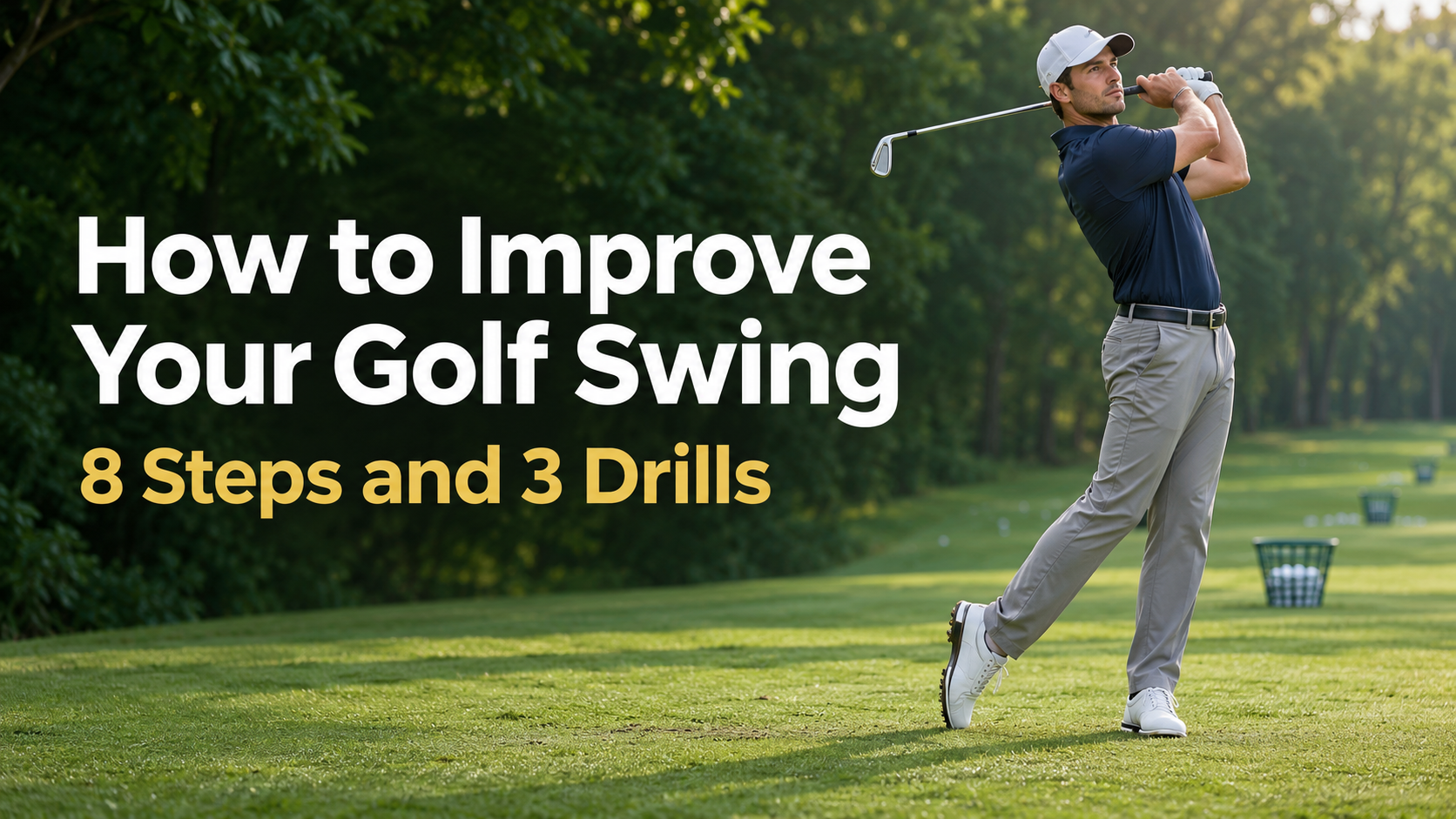
How to Improve Your Golf Swing: 8 Steps and 3 Drills
One 7-iron flies the right distance. The next comes up short, even though both swings felt the same. Before changing your takeaway or trying to swing harder, find out whether you hit the center of the clubface, where the ball started, and where it landed.
This guide walks you through eight steps for improving your full swing, along with three drills and a 30-minute range session. You can do the session with a mid-iron, a target, and a way to record your results.
Quick Answer: How to Improve Your Golf Swing
Start with a 7-iron and hit ten shots at one target. Track strike location, starting direction, and your most common miss. Check your setup, then use one drill that addresses the clearest pattern. Finish with ten shots under the original conditions to see whether the change improved your contact or tightened your spread.
Table of Contents
- Read your most common misses
- Eight steps to improve your golf swing
- Three practical golf swing drills
- A 30-minute golf swing practice plan
- Common practice mistakes
- Pre-shot checklist
- Frequently asked questions
Read Your Most Common Golf Swing Misses
Watch the first part of the flight as well as the finish. A ball that starts left and curves right calls for a different first check than one that starts right and keeps moving right. For strikes near the center of the face, face angle strongly influences start direction, and the relationship between the face and swing path helps explain curve. Off-center contact can change the flight, especially with a driver.
| Repeated miss | First check | What to track |
|---|---|---|
| Heavy iron shots | Where the sole first touches the ground | How often the club clips the ball before the turf |
| Thin iron shots | Whether contact is low on the face | Strike height and normal carry distance |
| Straight shots that start off target | Clubface aim and stance alignment | Whether shots start left or right of your target |
| Driver shots that curve sharply | Heel, center, or toe strike, then start direction | Which strike locations produce the biggest curve |
Use the table to choose a check. Several swing patterns can produce the same miss, so gather a few shots before drawing a conclusion.
Eight Steps to Improve Your Golf Swing
Step 1: Record a Ten-Shot Baseline
Warm up with a few easy swings, then hit ten balls with a 7-iron at one target. Choose a landing corridor between two visible range markers. Mark where each ball starts, where it lands, and how the strike felt. If the range allows impact tape, use it to distinguish heel, center, and toe strikes. Keep the mishits in your count so your next test has an honest comparison.
Step 2: Aim the Clubface Before Setting Your Feet
Pick a spot a few feet ahead of the ball on the line to your target. Aim the clubface at that spot, then set your stance. For a straight-shot practice baseline, lay an alignment stick safely outside the swing area along your toe line, parallel to the target line. Check your golf stance and alignment from behind the ball if the target suddenly looks farther left or right once you address it.
Step 3: Make Your Grip and Posture Repeatable
Set the clubface before taking your grip. Hold the handle securely enough that it stays steady when you make a rehearsal swing. If your forearms tense up before you move, ease the pressure slightly and see how contact responds. Hinge at the hips, soften your knees, and let your arms hang comfortably. Use the same golf grip basics and setup routine for each shot in the test.
Step 4: Check Ball Position for the Club You Are Hitting
For a stock 7-iron, try a position near the middle of your stance as a starting point. For a teed driver, try farther forward, near the inside of your lead heel. Your lead side is the one closer to the target at address. Test small changes and compare strike location and flight. If you change golf ball position by club, hold tee height and effort steady so you can see what the change did.
Step 5: Improve Iron Contact With Short Swings
Start with waist-high swings and look for the ball to leave before the club brushes the ground. On grass, use a line to see where the brush mark begins. On a mat, check for a low strike on the face or an unusually short carry, since the club can skid across the mat after hitting behind the ball. Lengthen the swing once the shorter motion produces reliable contact.
Step 6: Find a Tempo You Can Repeat
Make five swings with a comfortable rhythm and hold each finish for two seconds. Start the downswing smoothly and let the club accelerate through the ball. If you repeatedly step out of the finish or lose contact as you add speed, return to the previous effort level for a few swings. A balanced finish gives you feedback about the motion you just made.
Step 7: Match Your Change to the Ball Flight
If your iron shots start right and fly mostly straight, verify aim before trying a path drill. If centered shots with a driver repeatedly curve right, note whether they start left, straight, or right. That detail gives you a better starting point for learning how to fix a golf slice. For left-handed golfers, the slice curves left. Repeated heel contact is a reason to check strike before making a large swing change.
Step 8: Retest and Transfer the Change to the Course
Repeat the ten-shot test with the same club, target, and scoring criteria. Compare how many balls land in your corridor and how often your typical miss shows up. If the change helps, finish with three shots to different targets using your normal pre-shot routine. On the course, pick a target with room for your usual miss and take one cue from practice into the swing.
Three Practical Golf Swing Drills
1. Ground Line Drill for Heavy Iron Shots
Where the practice facility permits it, draw a short line on the turf perpendicular to the target line. Make five short practice swings with the line representing the ball. Look for initial turf contact at or just beyond the line on the target side. Then place a ball on the line and hit five half shots. Score how many produce ball-first contact. A shallow brush mark is enough feedback.
2. Start Window Drill for Direction
Choose two distant range markers that frame a small starting window. Aim the face between them, set your feet, and hit eight comfortable 7-irons. Count the shots that start through the window. Record curve separately so a shot that starts outside the window and bends back does not hide an alignment or face-control issue.
3. Three-Speed Ladder for Tempo and Driver Contact
Hit three drives at easy effort, three at your normal effort, and three slightly faster. Keep the target and tee height fixed. Use strike marks, if available, and compare the spread at each speed. If faster swings scatter the strike across the face, practice at the fastest effort that still gives you repeatable contact.
A 30-Minute Golf Swing Practice Plan
- Five minutes for warm-up. Start with short swings and gradually move to your normal 7-iron motion.
- Seven minutes for your baseline. Hit ten balls and tally solid strikes and shots that finish in your target corridor.
- Eleven minutes for one drill. Choose the drill that matches the clearest miss. For a driver-specific session, take both ten-shot measurements with the driver.
- Seven minutes for your retest. Return to the original target and repeat the ten-shot tally. Record the result and the cue you used.
Suppose six of your first ten shots land in the corridor and eight of the next ten do. Repeat the comparison on another day before deciding whether the improvement holds. Use the same club and a similar target width so the scores are comparable.
Common Golf Swing Practice Mistakes
- Changing several things at once. Test ball position, grip, or tempo separately so you can see which change affects the result.
- Judging a change by your longest shot. Compare the whole shot group, including the miss you would have to play from on the course.
- Using a drill for every shot. Alternate drill reps with normal swings to find out whether the change carries over.
- Changing path based on one slice. Check strike location and start direction across several shots first.
Pre-Shot Checklist
- Choose a target with a landing area wide enough for your usual shot spread.
- Aim the face at an intermediate spot and set your stance.
- Check ball position for the club and shot.
- Make one rehearsal with your chosen cue, then commit to the shot.
Frequently Asked Questions About Improving Your Golf Swing
1. What should a beginner work on first?
Start with setup and reliable contact using a mid-iron. Short swings make it easier to notice whether the strike is centered and whether the club touches the turf before or after the ball.
2. Why do I hit my irons well but slice my driver?
The driver’s longer shaft can make centered contact harder to repeat. Check where the driver strikes the face and where the ball begins its flight. If centered shots still curve sharply, a coach or launch monitor can help you check face angle and path.
3. Can I practice my golf swing at home without hitting balls?
Yes. In a space with enough clearance, rehearse your address position and make slow swings with a balanced finish. Save contact and ball-flight tests for the range.
4. Should I film my golf swing?
Yes, if you have a specific question. Set the phone safely outside the swing and ball-flight area. Record a face-on view to compare ball position, or a down-the-line view to see your setup and motion. Keep the camera in the same place when comparing clips.
5. How long does it take to improve your golf swing?
Setup changes can affect your shots in one session. Whether they produce lasting improvement depends on how consistently you can repeat them. Compare the same test across multiple sessions and check whether the result carries over to the course.
6. When is a golf lesson worth booking?
If the same miss keeps returning after you have checked setup and contact, bring a coach your ten-shot results and a short clip. That gives you a specific pattern to work on and a baseline for measuring the lesson’s effect.
Final Takeaway
Give your next range session one job. If your irons keep coming up short because you hit the turf first, work on ball-first contact and tally the result. Once the pattern improves across several sessions, move on to the next miss costing you shots.
Instructional sources: PGA of America on ball-striking drills, PGA of America on alignment practice, and Trackman on club delivery and impact. The practice schedule and scoring examples are illustrative.